

BUILDING EMPATHY FOR PEOPLE WITH DEMENTIA
The making of MemoryWell, a new service in dementia care
Why this project mattered to us: Along with losing the wherewithal to take care of themselves, people with dementia often struggle to communicate their needs and emotions in a way that other people understand. They don't become any less human than anyone else, but for paid caregivers, it's a challenge to engage fully with people with dementia. Something about their perceived humanity can degrade.
Context and objective: Collaborating with several team members, I researched how the dementia-care industry collects and shares biographical information about Alzheimer's residents to humanize them and also help soothe agitation. We also studied the behaviors and needs of four main stakeholders: memory care executives, nursing staff, families, and of course the people with dementia.
Summary result: Our research revealed numerous weaknesses in the status quo system, and one result was my cofounder and I started a service creating digital life stories for people with dementia.
My role: Design research, UX architect, business development
Time frame: 11 months starting in 2015
Project phases
Note: To respect patient confidentiality, I’ve changed some names and details and used a stock photo of the elderly woman.
KATE'S STORY: A PROBLEM IN DEMENTIA CARE

Kate Glass always hated her formal name Katherine
Kate Glass was miserable, and the nursing staff in Peace Grove Village's dementia-care unit where she lived were at their wit's end.
Kate sobbed often, and many nights sleep wouldn't come. She paced the hallways for hours, sometimes stealing into other residents' rooms as they slept and raising complaints from other families. Nurses couldn't figure out how to soothe Kate, how to help her feel happier.
But Kate's daughter Samantha knew the source of the problem.
One indication was the name nurses kept calling her mom: Katherine. Kate hated the name Katherine. But the nurses kept using her given name even though Samantha had been trying to get them to change for two years. Katherine was the name on the patient record.
It was a sign, Samantha believed, that Peace Grove's nurses didn't understand her mom well enough to calm her agitation and provide the care she needed, and perhaps didn't relate to her as an individual.
CONTEXT OF U.S. DEMENTIA CARE

The U.S. has about 5.5 million people with Alzheimer's, which is expected to increase to 16 million by 2050, according to the Alzheimer's Association.
In the U.S., about 5.5 million people have Alzheimer's, according to the Alzheimer's Association. Some residential providers in the memory-care industry have recognized they need to know more about each individual resident to improve their quality of care and make themselves more attractive to families.
Healthcare regulations developed in the wake of Obamacare also incentivize improving what people in the memory-care industry call person-centered care.
INITIAL ASSUMPTIONS
We thought that memory-care providers knew very little about the people in their care, and we hypothesized the informational scarcity resulted from the disease itself.
From desk research we knew that by the time someone moves into a dementia-care community, the disease has usually progressed to such a degree that the person has difficulty telling her own story, thus inhibiting care providers' ability to learn much about the person.
EXPLORATION: TALKING TO STRANGERS
To test our early assumptions, we sought interviews with people who would know about how the memory-care industry works, typical clinical requirements, and the daily work flows of staff in memory-care units.
We recruited and interviewed 15 people.
Academics who study dementia
Nursing home executives
Dementia nurses
Dementia-care consultants
Elder-care entrepreneurs
Families of people with dementia
Nurses aides
Association staff
What we learned: forms of biographical information collection
The interviews yielded insights that contradicted our initial assumptions.
We learned memory-care providers usually collect from families extensive information about their residents when they move in.
Most of it is on federally mandated forms that are largely medical in nature.
Many companies supplement those required forms with additional, pages-long paper questionnaires that ask about residents' histories and preferences.


Five of the 11 pages of one life history form currently in use
They typically ask for the names of the person's parents and siblings, whether he or she prefers to sleep in late or wake up early, and numerous other details.
Form questions, lengths, and formats vary widely.
What we learned: mini-personas
Memory-care executives
Care about: Boosting profit and revenue, avoiding fines, professional reputation, care quality
Says: "We always struggle to keep our beds fully occupied and turn a decent profit. The industry is growing so much, but we live and die on word of mouth. We have to find a way to stand apart from the crowd."
Memory-care nurses
Care about: Following regulations, keeping residents safe, completing tasks
Says: "I love my patients and I really want to get to know them better. But it's hard sometimes. We're so busy and usually understaffed. It's really hard to keep up just with our daily tasks."
Family of person with dementia
Care about: Ensuring loved one is safe and happy, assuaging a sense of guilt
Says: "Moving my mom into dementia care was perhaps the most wrenching day of my life. I know that nurses are trying hard, but sometimes I'm afraid my mom will get lost in the mix amid all the other people they have to take care of."
To make sense of our findings, I facilitated a group workshop where our team members organized what we learned into themes.
The interviews revealed these paper forms cause problems and undermine the system of personalized attention and care they're supposed to encourage.
We identified several key pain points for the stakeholders.
-
Daunted by the lengthy history forms, families usually don't complete them until months after the critical move-in period -- a period when staff most need that information to acclimate new residents.
-
Families often don't provide enough useful details and context on the forms for staff to get to know residents well and build a relationship.
-
The paper itself is a problem. Sometimes the forms get lost or damaged.
-
Nurses dislike reading the forms. They're usually dryly written and sometimes the handwriting is illegible. In one nursing home, I was shown a three-ring binder of completed forms covered in dust at the nurse's station.
-
Nurses sometimes have trouble understanding how to apply the forms' information to situations where they need to calm down agitated residents.


Life story forms often end up getting ignored by memory-care staff. I saw one binder of completed forms covered in dust at a nurse's station.
One thing was clear from the interviews: Nurses and family members wanted something to help build empathy for the people with dementia and provide ideas for activities that could soothe agitated or aggressive behaviors.
SYNTHESIS: BUILDING EMPATHY FOR USERS' PROBLEMS
For all intents and purposes, life history forms might as well not have existed in memory-care units.
A new solution was needed.
DESIGN AND TESTING: IDEATION AND SKETCHING
Our research uncovered unmet needs for biographical information about residents presented in a digestible, quick-to-read format that can be easily accessed by nursing staff and family members.
As longtime journalists, my cofounder and I had several ideas, from digital timelines to short videos to photo slideshows.
But we settled on what felt most natural to us as writers: Craft compelling life stories that capture something essential about the person with dementia.
We wrote a sample life story that was originally about 1,500 words so that we could get quick feedback on content, format, tone, and the usability of life storytelling in dementia care.
Early user testing revealed areas for improvement
We sent the sample to prospective users: a family member of someone in memory care, a director of memory care, and a different senior-living executive we'd gotten to know.
They said the stories had the kind of information they needed to understand their residents and the tone was about right.
But it was too long. Nurses would not have the time to read it.
And all three said they'd love to have additional photos and maybe even music to go along with the stories. Photos from different periods in a person's life would make concrete the fullness of their lives. Music is a powerful tool for engaging with people with dementia
We cut the story word count by two-thirds, so it could be read in three or four minutes.
I sketched some possible website layouts, and with a team member produced some simple, conceptual wireframes.
We then worked with a web developer to create a website based on the designs, and soon after I persuaded a memory care provider in Chicago to let us create our first real story page for one of their residents.

A sketch I drew of a website layout.

A user flow I drew for two types of users: family members and nurses
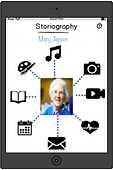

Some early, conceptual wireframes a team member and I created.
USABILITY TESTING
I conducted remote and in-person usability tests with 13 participants, six of which I recruited at random at a senior-living conference. In eight cases, I stood near the person exploring our new story page and took notes as she described aloud what she was seeing and thinking.

This provided important feedback on which sections of the page drew immediate attention, which sections users skipped past quickly, and generally how the users felt while going through it.
For example, I realized that users were gravitating immediately to the individual photos and their captions interspersed with the story text. Some users joyfully said, "awww" as they looked at the old photos. As a result, we added a photo gallery with captions toward the top of the page to hold photos in addition to those throughout the story text.
I carried out remote usability tests with the remaining participants, either sharing their screen or speaking to me on the phone while on our story site.
MORE FEEDBACK, MORE DESIGN TWEAKS
We spoke with a director of nursing at another memory-care provider and some family members of those with loved ones in dementia care to further test our design.
The director of nursing told us something important about a problem she faced.
Transferring residents from one set of nursing staff to another was particularly troublesome because much information about patients' preferences often got lost in translation.
It led to miscommunication and frustration among nursing staff and families.
Interviews with family members also helped us understand something critical about their experience. In different ways, family members had told us they felt guilty about being disconnected from their loved ones' care.
But through these interviews we had begun to understand that families were searching for ways to remain involved, to feel like they could make an impact.
So we added a small interactive list at the top of the story page summarizing the person's most important family members and preferences. Later, we added lists of tips for easing loved one's agitation and ideas for ways to spend time with their loved ones that family members would directly suggest.
Feedback from the nursing director and the families confirmed these changes met their needs.
And we started noticing a change in how people perceived our product. Whereas at the beginning people seemed to understand our product as simple life stories for people with dementia.
The design changes made it more apparent that MemoryWell was becoming a toolkit for connecting nursing staff with family members and those with dementia.
Thank you to Becky Michelson, EL Hartnell, Tim Bober, Glenn Espinosa, and JNS -- and the many other people who helped and offered support along the way.